Case: Multi-layer and structured ceramics inspection
Ceramics are typically highly scattering and therefore it can be challenging to inspect ceramic components. The below figure 1 shows how MIR-OCT can be used to visualize lay thickness, uniformity, structures and defects in two types of ceramics: Zirconia and alumina. Figure 1(a) shows an illustration of the test sample, which is a ceramic stack composed of a zirconia plate (C1) and two alumina plates (C2+C3). The middle plate (C2) has various structures inscribed, which can be visualized when inspected using MIR-OCT. Figures 1(b) show a 3D view of the OCT data obtained when scanning the stack from the bottom through the alumina plate C3. The structure in the alumina plate C2 is very clearly seen in a top-down view, as shown in Figure 1(c). Scanning instead from the top of the stack through the zirconia plate C1, we can see that this ceramic plate is highly scattering and presents multiple defects. Even so, it is still possible to detect the backside of the structured alumina plate C2.
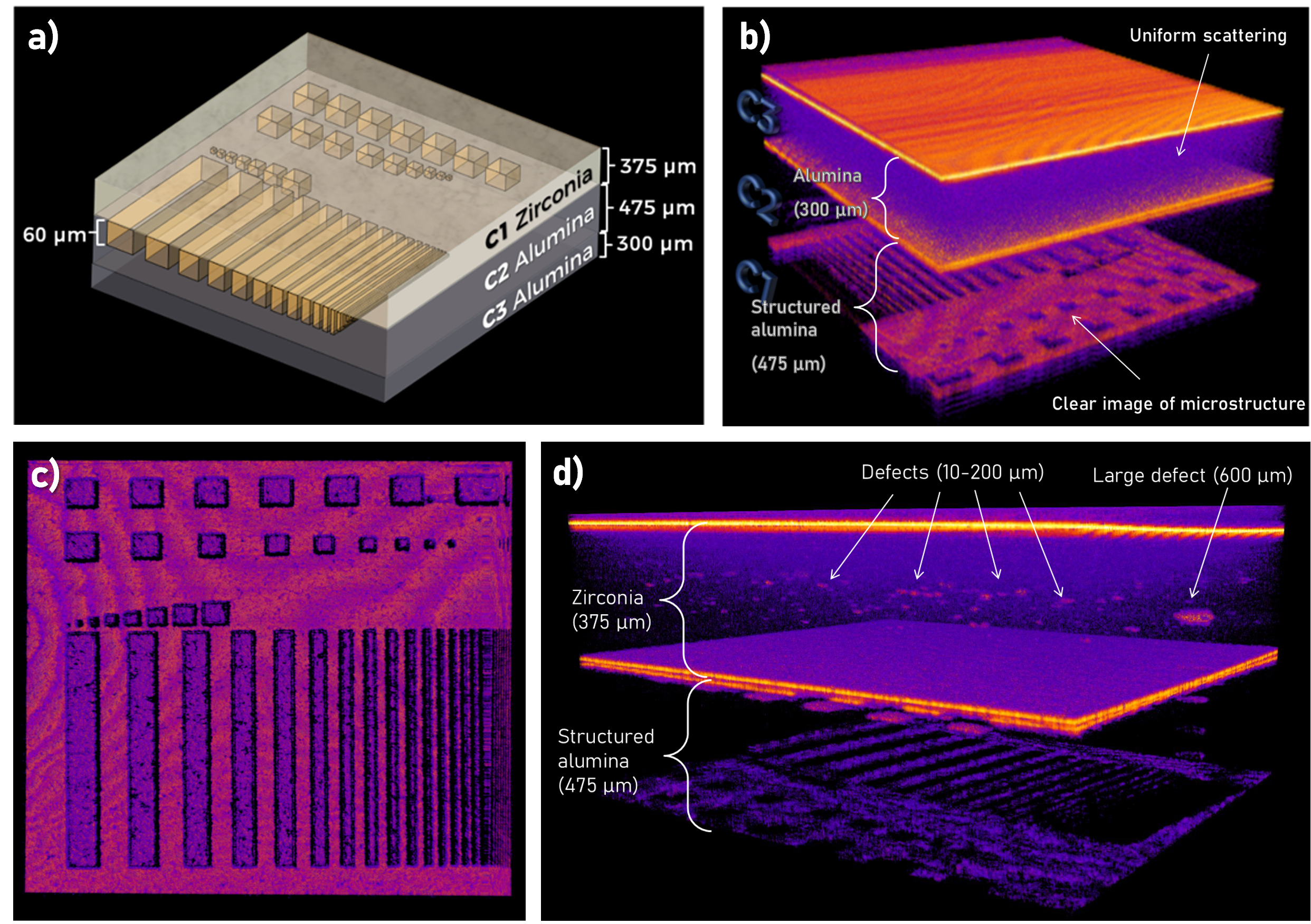
Figure. 1: MIR-OCT inspection of a ceramic stack with an embedded microstructure. (a) Schematic of the ceramic stack. (b) 3D scan of the stack when scanned through the alumina plate C3. (c) The microsctructure of alumina plate C2 visualized through alumina plates C2 and C3 (775 microns). (d) 3D scan of the stack when scanned through the zirconia plate C1.